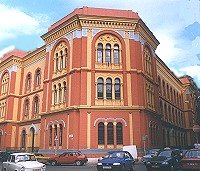
The Miraculous Escape of the Residents of the Bogár Street Children’s Home.
Éva Stiasny Bartos
At Peace in War
The Miraculous Escape of the Residents of the Bogár Street Children’s Home.
******************
© Eva Stiasny Bartos’s legal successors Translation: Bernadette Filotas Giguere Edited by Elizabeth Csicsery-Ronay
In Hungarian: © Luther kiadó 2005, 2010
1
******************
Éva Bartos Stiasny looks back over the decades at Gábor Sztehlo’s child-saving mission. The Lutheran minister’s work took place during war-torn Hungary.
The book which is of historical significance entitled At Peace in War was translated into English by members of Éva Bartos Stiasny’s family who ended up scattered over various countries.
These selfsame members, who left Hungary after the II. World War in the hope of finding a new homeland, joined together to produce this volume.
Rev. Dr. Andrea Krasznai ******************
2
Preface
The names and deeds of successful or not so successful politicians, and of victorious or defeated leaders in the stormy periods of history, are preserved and passed on to future generations in books, scholarly works, street names and statues erected in public squares. Some great writers, a few poets, now and then an important scientist merit such homage from those to come. For those who did not win public recognition on the battlefield or on the political stage, or who did not create something lasting in the form of a work of art or scholarship, who “merely” undertook to save the lives of several thousand children and, in doing so, risked their own lives and the safety of their families – for them there is only oblivion. Perhaps not even Raoul Wallenberg would be remembered were it not for the fact that his shocking, outrageous kidnapping and death have made his work of saving lives enigmatic and well-known.
Gábor Sztehlo hid, protected and fed several thousand persecuted children during 1944-45. Nevertheless, his name is known only to a small number of people, mostly those whom he saved and who are still alive (among them, the children of Bogár Street, about whom this book is written) and their families. In other words, he is known only to a few devoted
The picture is from havasi.sed.hu/sztehlo
admirers. Yet this Lutheran minister, with his gentle manner and endearing smile, was a genuine hero. His courage, generosity and self-sacrifice were unmatched. Although there is a memorial tablet in Budapest and a tree in Jerusalem to remember him by, his name is not generally known in Hungary. Unfortunately, the witnesses mentioned above do not have a powerful enough voice and their means are too limited to perpetuate the memory of Gábor Sztehlo’s exemplary heroism, to recall and keep alive his memory, to win recognition for his name, and to make him known to the general public.
Gábor Sztehlo voluntarily took on the responsibility to care for and bring up the orphans created by wartime atrocities, children whose parents would never return. The number of such children multiplied over the years. The Children’s Home run by the Good Shepherd Foundation took them in.
Gábor Sztehlo was not only a hero but was also a remarkably talented teacher. With this institution, he realised his long-standing dream – he established the Children’s Republic called Gaudiopolis, a model, self-governing democracy, with the responsibility for decision-making, the establishment of rules, discipline, cultural development and the allocation of physical work to the teenagers.
3
With a pedagogical sensibility similar to Pestalozzi’s, and his resourcefulness and boundless tact, he was able to work, sternly but with good humour, with this system of self-government and with the duties and work that it entailed. His aim was to heal the spiritual wounds left by war, persecution, and loss of parents and, in as far as possible, to eradicate the scars, and treat the anguish and depression caused by the horrors that these children had experienced.
Both his great achievements, saving the lives of thousands of children and, as teacher, treating and healing their damaged psyches, were miracles, miracles in a country in the midst of collapse and disintegration, seemingly without any hope. However, when his work was done, they took it away from him, removed him from its direction, and thus in effect destroyed his entire life’s work. He died in Switzerland some years later while serving the Church as dean in Interlaken. He was within a few months of gaining citizenship so that he could return home after an absence of ten years. This, too, was denied him.
And so the name of the miracle-worker Gábor Sztehlo gradually fell into oblivion.
The author of these lines ended up in his institution after the war and became, as an adult, his close friend. I last saw his ever-warm smile from a window in Interlaken, from which he waved goodbye. A goodbye for ever.
Since then, I speak of him at every opportunity, to make known his incredible spirit and courage, and his astonishing achievements. Perhaps this book can contribute a little to making Gábor Sztehlo more widely known.
Budapest. May 31, 2005.
Ádám Horváth Director
4
New York, August 19, 1986.
“It was an unforgettable time for all of us. It is interesting that, as the years pass, I think back on it more than when I was thirty or forty years old.”
New York, August 15, 1972.
“In those dangerous times, Aunt Éva’s solicitous anxiety for us was combined with amazing composure worth its weight in gold and with some kind of internal strength warmed through by unshakeable calm.”
(Extracts from the letters of Gábor Vermes)
*******************
The lines quoted above, by a former Bogár Street Home resident, now a retired professor of history at Rutgers University in New Jersey – and questions from my grandchildren and their
friends – have compelled me to bear witness to the merciful providence of God by writing a brief account of the miraculous escape of the Bogár Street children. In this way, not only adult readers, but also the children of today can come to know in religion classes and in youth groups, how children and young people pulled through the siege of Budapest and how they experienced God’s help. For we certainly often repeated: “Thus far has the Lord aided us!” (1 Sam 7, 12).
Éva Bartos, née Stiasny (Aunt Éva).
Éva Stiasny’s International Red Cross identity document
5
Background
Gábor Sztehlo had time and strength only to sketch an outline of the events of 1944 in his diary, now published under the title In God’s Hands. He wrote briefly of the life of the 32 shelters where he saved about 2000 persons from certain death. His notes ended up in Éva Bozóky’s hands. She told me that she had taken these sections of the diary apart and then, using her own authorial skill, strung them together again like pearls.
There was even a film made about Gaudiopolis, Somewhere in Europe. Although, to suit contemporary political expectations, it made no mention of the fact that Gábor Sztehlo was a Lutheran minister, it did pay due homage to the man who saved these children.
Several articles praising Gábor Sztehlo also appeared in Élet and Irodalom [Life and Literature], Nők Lapja [Women’s Magazine] and Evangélikus Élet [Lutheran Life].There is also an article in the August 2002 issue of Kortárs [Contemporaries] by Mónika Miklya Luzsányi. It presents, with serious mistakes as to chronology and events, the recollections of the workers there and of those who were rescued. She later wrote a novel about these events but, unfortunately, there are several mistakes in that, too.
One can certainly identify the expectations of the period when these works about the life and service of this great rescuer of children were written. (A good example of this is that in some, Pestalozzi figures as Sztehlo’s pedagogical model, in others, Makarenko does). This is why there are so many misunderstandings, mistakes or generalisations and “literary exaggerations” in it.
As winner of a Soros Foundation scholarship, Zsuzsanna Merényi wrote a study of Sztehlo’s pedagogy titled Gábor Sztehlo, a gyermeknevelő_ [Gábor Sztehlo, the Teacher of Children]. Here, as she points out, she writes about the period before Gaudiopolis only to the extent necessary to explain the operation of the Children’s Village.
In these works, therefore, there is little mention of the Bogár Street Home, the institution which was in the most hopeless situation. That is why I feel I must write the truth out of love for my Bogár Street “children” while I still have the strength. I would also like to answer in more detail the question posed by Erzsi Sándor on Petőfi Radio on January 26, 2005: “How did you manage to get the residents out of the Home in three hours on the night of January 3, 1945, when it was in the line of fire?” All I could actually say was, “We were sheltered under the wings of Jesus spread protectively over us”. I would like to testify to this certainty in this little book, too.
From the Dean’s Office to Bogár Street
I started helping out at the Lutheran Pastoral Office, directed by the dean, Lajos Kemény, and located on Damjanich Street, in the summer of 1944. The church on the Boulevard and the secondary school were connected through the boarding school to the Damjanich Street house; the Dean’s office was located on the ground floor. Most of the residents of the building were pastors or secondary school teachers.
6
By this time, not only Budapest but the entire country too was suffering from the consequences of the German occupation. The capital, for example, was put on notice by the carpet-bombing of Andrássy Street. Increasingly, the bombs were falling on residential buildings. One could see the cables of the ruined subway through the shattered pavement. The call-ups for military service came one after the other as the military trains headed eastward. More and more pastors’ families fled to the capital to get away from the fighting. The church orphanage on Rózsa Square was filled with war orphans. András Keken, the pastor of the Deák Square community, sheltered, in his own home, the little residents of the Children’s Home that he himself had founded in Mezőberény.
Help was also needed at the Damjanich Street Pastoral Office. Day after day, it was full of converts (Jews who asked to be admitted to the Church), who were trying thus to escape the horrors awaiting them. There were dreadful stories from the West about the concentration camps and here at home, too; the obligatory wearing of the yellow star was degrading.
On the day following the failed attempt to withdraw from the war, Dean Kemény called me to his room. To this day, I can see him before me, sitting at his desk with the telephone in his hand. He said, “Gábor Sztehlo is on the line. He says that there are many children at the Children’s Home on Bérc Street, but few teachers. ‘That is why I would like to know if you are there now, and will be there in the time to come’”. The children are many, the teachers are few! By that evening I was in the overcrowded Haggenmacher villa on Bérc Street. I became the mother of the little boys. But not for long…
A few days later we arrived at 29 Bogár Street in a Red Cross minibus. It turned out that there was an even greater need there for my work. Gábor Sztehlo’s only instructions to me were, “Learn a lot from Lujza and do everything as we do at the Luther Circle”.
The director of the Home was Lujza Benes, a highly respected special education teacher. She had come back from Switzerland on official business and was marooned here for the time being. She got back to her sons in Geneva later, when she went as escort on the last train carrying children to safety. Until then we worked together with great affection.1
Gábor Sztehlo wrote about this in his diary: “The question of keeping busy arose among the problems of the first weeks once that group of children was slowly organised. I had two outstanding assistants in this: Lujza Benes and Éva Stiasny. Lujza had experience directing a Children’s Home, she was a special education teacher, her parents and brothers and sisters lived in Budapest and were influential people. The committee chose her to take a group of children across the border to Switzerland. While she was waiting to go, she volunteered to work at Bérc Street to train the care-givers, introduce a system of work, and set up the structure of the Home. As for Éva Stiasny, she had wanted to train as middle-school teacher [I had completed the training – my correction, É. S.]; she was intelligent, self-sacrificing, practical and capable of directing others. I knew her from my days as assistant pastor, when she was the youngest member of the Youth Group at the Boulevard community. She took over the responsibility of occupying the children with their daily routine of study and free time, in this way filling the passing hours with useful activity. She was really good at this; she soon taught them short plays and the children learned how to entertain each other. Later the two girls [teachers – É. S.] showed other institutions being set up how to proceed” (Sztehlo
1She made me very happy when she, at age 80, sent me a card in which she wrote that she thought about me often and that she hoped to tell me this one day.
7
1994: 61). I was proud of Sztehlo’s confidence in me even during the hardest times. Even when the Soviets took him off for “malenki robot [just a small job]”…
Joys and Sorrows
Gábor Sztehlo was chaplain of the Boulevard community when I was confirmed. All I knew was that he led the Luther Circle of the bigger children. Since there were many of us being confirmed, a “little circle” was set up under the leadership of László Danhauser, the pastor who was the religion teacher. My job in this community was to organise “cheerful” get- togethers. I cherish many beautiful memories of that period. The children of the intelligentsia, as well as of “simple” people, participated equally in Bible Study classes. We often presented the plays and tableaux, which I taught them. “Running the circle was the particular responsibility of the young people, since this guaranteed their connection with the community after confirmation. The collaboration of the young people can be viewed as an experiment, since it was necessary to devise an attractive, colourful programme to appeal to children who were of many different social situations” (Merényi 1993:8).
I knew Chaplain Gábor Sztehlo from my Luther Circle days as one who could never refuse a request made on the so-called “Assistance to the Poor Day”. If the collection box was empty, he reached into his own pocket and even into the official-reserve fund to supply the needy. At times like this, his grandmother, darling Mrs. Haggenmacher, made up the money so that there would be no shortfall in the cash box. Prof. Dr. Tibor Fabiny said at the opening of the Sztehlo exhibition ten years later, that the Haggenmacher factory gave substantial financial support to set up the homes.
Sztehlo’s ideas were also much influenced by the People’s School movement, those experiences which he brought from Finland and those which he acquired at the People’s College that he set up in Nagytarcsa.
It was also important for me that I was not quite a beginner when I was entrusted with this unexpected task. After I received my diploma as specialist in Hungarian, German and French in 1941, I taught religion at the Girls’ Middle School run by the Scottish Mission in Budapest. Aunt Olga Rázga fell ill suddenly, and I was given the honour of replacing her among respected, elderly teachers. I even got Aunt Olga’s lesson plans and her class which, according to school tradition, sponsored a poor family with many children. Beginning with autumn, we collected outgrown clothes and toys in the classroom cupboard. We set up a tree at Christmas and prepared a holiday programme. On December 23rd, we took everything to our “family” at the Mária Valéria settlement and presented our programme again.
Among the many other blessings that I received through my work, I became acquainted with serious social problems and with poverty. For example, at Angyalföld, where I also taught religion, a little boy did not want to take part in the Christmas celebration, because his mother did not have a single pair of shoes without holes that she could wear to come to see him.
I think back with respect to this school, which included the teachers Zsófia Victor (daughter of János Victor), Olga Rázga, and Miss Haening [sic – Haining], who accepted martyrdom for the sake of her pupils. People should know that this Scottish director was among the first to be
8
taken away because she hid children and families of Jewish origin at the boarding-school. (She is commemorated on a tablet in the assembly hall of the former school on Vörösmarty Street). Her self-sacrificing love is demonstrated by her act of having her own suitcase cut up at Christmas 1943, so that there would be leather for a pair of shoes for each of the teachers. When her successor, Zsófia Victor, tried in the winter of 1944 to get a parcel to her in prison, she was informed that where she was, there was no need for parcels… This was how we learned of her martyrdom. She could have escaped in 1942 when the organisation that sent her called her back to England. But her response was, “I will not leave those in tears whose smile I once enjoyed”.
Finding a Home
But back to the events! It was a long road, with many detours, that had to be followed before Gábor Sztehlo opened the first Children’s Home in the Haggenmacher villa on Bérc Street. Some time earlier he had already got in touch with the Jewish mission organisation of the Lutheran Church, the Good Shepherd Mission Subcommittee. They did not have the resources to do more to help the persecuted but Stehlo had already begun busying himself with finding places for abandoned children. The solution came as a result of an unexpected meeting: Sándor Bonnyai, the Lutheran minister who was the director of the Christian Youth Association, asked him to interpret at a conference with a “Swiss gentleman”. Bonnyai hoped that this gentleman would be able to help carry on the work of the CYA. It emerged during the conference that the gentleman was none other than Friedrich von Born, the Swiss representative of the International Red Cross, who had come with the intention of persuading the CYA to take up the cause of the persecuted children. The CYA could not do this, but the interpreter, Gábor Sztehlo, accepted the commission.
Born had previously got Rózsa and Júlia Vajkai, the highly-respected Hungarian representatives of the International Save the Children Union, involved in the aid programme. This was how the actual work got under way. (It is a sign of the trust put into these no longer young social workers, or rather of their reputation, that the first Red Cross parcels to come to Hungary from Switzerland after the war were addressed merely to “Vajkai Hongrie”, but nevertheless got to them.) In his diary, Sztehlo recalled the negotiations thus: “Born got to the point quickly: The establishment of shelters has to be under the auspices of the International Red Cross. Will I take on the responsibility?
Since I have been working on this for months, of course I will!
“At that moment, the door-bell rang. Two visitors arrived, Rózsa Vajkai and a man who was the leader of the illegal “Joint” group. After exchanging greetings, Born announced that the leader of “Joint” would direct the A section and I the B. Jewish children would belong to A and converts to B. Rózsa Vajkai (that is, the International Save the Children Union) would provide food and supplies for both sections. A great many children were already waiting to be placed.
“I mentioned at this point that the most important thing was still missing. Where were we going to put the children? There is no house, apartment or villa – in a word, no building. Joint, I hear, already has such a Home in Orsó Street. But where am I to put A section? I tell my tale
9
of mishaps, how the Fascist lawyers cheated me so much that I had to leave Budapest. Born could not come up with advice immediately but he smiled:
‘There is already a villa in Bérc Street. You probably know the owner: his name is Otto Haggenmacher.’
“Once again I am astonished: this is my mother’s cousin. It seems that Born had mobilised the family. So now I can start talking with the children’s parents, relatives, to send beds, bed linen…” (op. cit., 53-54).
Sztehlo and the Vajkai sisters, with their long experience in social work, knew that for the Homes to be real homes, unexpected guests (a delegate, Born, etc.) should be able show up at any time. It was essential that not slums be set up, but homes for children, with a family atmosphere centred around the children. “This explains why, when the siege forced them at the peril of their lives to abandon the house, they carried out Aunt Éva’s directions in an orderly way” (Merényi 1993: 16).
Life at Bogár Street
By November we were established with the children in a beautiful villa at 29 Bogár Street, on the highest point of Vérhalom. There was a marvellous view of the city from the house. It had an enormous garden (today this is a nature reserve). We really needed it because the children were not permitted to leave the grounds of the boarding school, nor could we receive visitors. We made as much use of the garden as we could.
Sztehlo writes in his diary: “The Bogár Street villa stood on the Rózsadomb plateau in a beautiful, well-maintained garden. We liked it at once. Its size and layout made it possible to accommodate 45 children. We brought in boys between the ages of two and nineteen, but the majority were adolescents. Lujza Benes directed the Home at first and after she left for Switzerland, Éva Stiasny took over. We concealed János Klump here, together with his younger brother, and Mrs. Hahn, whose daughter was already in the Bérc Street home. The Bogár Street home seemed to be in the most danger of all, but our charges succeeded in overcoming the greatest hardships with solidarity and cooperation. They stood firm in the midst of the gravest danger, and that was when they laid the groundwork for the future Gaudiopolis” (op. cit., 67-68).
We took the villa over from the concierge and the former housekeeper. The house was furnished with costly furniture. We set up the little cribs of the small children among the furniture. The bedroom door of the person in charge was always open, even at night, since it was important for the little ones to feel a maternal presence close by.
Of course, there were things in the building that were useful for furnishing rooms for adolescents as well. They made up a nickname, “couch-cot”, for the folding cots on which we could put brand-new, snow-white bed linen. There were even pillow fights in those rooms… We made sure that every child had his own little nook where he could be by himself for a bit. There was a separate place for school supplies.
10
We kept track of our children not by way of an alphabetic list but by the location of their couch-cots in the dormitory. Indeed the time eventually came when we had to learn a new list of names, the aliases. It was a horrible thing for me, to be obliged to teach little children to lie, and to say to them: from now on, your name is such and such, your parents are so and so… But the problem was solved.
We worked out a daily schedule as far as possible under the circumstances. Waking up was followed by washing, dressing, making beds and tidying the rooms, then, after a short prayer, breakfast in the hall on the ground floor. This was when we discussed the duties of the day. Looking after what had to be done that day, arranging the tables, setting them, supervising the room – all conferred prestige on the person charged with the responsibility.
After breakfast, the younger ones sat around the table to study. Closest to me were the first graders who got special help in learning to recognise the letters of the alphabet. (When we were joined by Pali Fóti, who was in teacher-training, I handed the first graders over to him.) Some had managed to bring school supplies with them, and we got copybooks and textbooks for the others. The children in middle school were taught by the big boys (aged 16 to 18), who rejoiced in the title of “Uncle”. The time spent in preparing the classes proved to be a useful occupation for them too. For example, Peti Hofmann taught history, András Róth art history, his younger brother Gyuri biology, Egon French, Gyuri Oláh arithmetic and physics. The books left in the villa were a help too. The children learned a lot of poetry and even a little play which they presented to the “Reverend Uncle” and the guests who came with him. These people were happy to come because here they were free to enjoy themselves without the threat of an Arrow Cross raid. The Arrow Cross ransacked hospitals or poor-houses even though a tablet stated that these buildings were under the protection of the International Red Cross. It was, therefore, a genuine miracle that the Sztehlo Homes were never raided, although occasionally a policeman got to the entrance…
We placed the bigger boys, the “uncles”, upstairs in two smaller rooms. Together with the young “aunties”, they helped us in the daily work on the ground floor. There were also some adults living with us: the above-mentioned Cili Hahn, one of the most versatile workers in the office, and János Klump and his younger brother Egon, who had fled here from Vienna. They were not only residents, but our liaison with the office. They helped us more and more when the fighting around us began to get worse.
Lilike Hetényi was also with us, together with her daughter-in-law and grandchild, a baby. Goodness, but we had use for Lilike’s help! She did her practical best to smooth out the “uncles”’ damp shirts with the mangle instead of ironing them, and to persuade them that the Swedes did not iron their underwear…
Looking after the kitchen was Aunt Boris’s job. (Her son worked as chauffeur for Born, the Swiss Red Cross representative, when there were visitors.) Aunt Boris’s daughter Panni helped out in the kitchen, as did Vali, Dolly and, later on, Hedda, too. We tried hard to make sure that each of us did his or her share of housework. At the same time, we also shared the more pleasant jobs, reading to the little ones and playing with them in the afternoon.
When circumstances permitted, we played outdoors in the outdoors. The children were forbidden to go near the garden gate or the fence along the street, lest passers-by notice the large number of children.
11
Nevertheless, we did once stop breathing. We did not see Gyurika among the children in the garden. I went into the house, thinking that perhaps he was inside. I couldn’t find him. Lujza and I exchanged desperate looks: where did he go? At that moment, the bell at the gate rang. We peered out. A policeman stood there with Gyurika. He explained to him kindly, that it was safer and better for him to play here, than to visit his godmother in the midst of an air raid. After the policeman left, Lujza opened the gate in front of the children and announced that anyone who was not satisfied with us – here was the gate, open – go! An appalled silence fell. No one moved. But we embraced Gyurika joyfully; we were so glad he had come back to us safe and sound. From this time on, I felt that we received more love and tighter hugs from the children at night, for they saw that we were there for their sakes. Lujza and I felt, and made the others feel it too, that God was with us in this Home…
After the midday meal, there was a rest period, followed by games in small groups and the reading of story-books. The young “aunties”, girls of 16 to 18, helped us in this. Dolly supported us diligently and sweetly. If she noticed a child falling silent and looking sad, she went over to him with her Bible. She even gave Tomi Kilényi one for Christmas. In the meanwhile, I had to summon one child or another to the bathroom, since, after all, we had to solve the problem of bathing the little ones. The bathroom on the upper floor was for the little ones, and the one on the ground floor for the big ones. The schedule had to be strict, because our numbers were constantly growing. They came after dark, relatives with tears in their eyes, holding placement forms, and handed their frightened children trustingly over to us. We ourselves strove to calm the children’s fears, so that they would feel that we would take care of them now instead of their father and mother,
This is what Sztehlo says in his diary about those days: “Previously I had known only Stiasny Éva. I met the others only when I took them into the Home and when I went to visit. Now I realised what admirable, self-sacrificing people they were. Except for Éva, none had belonged to a Christian community before, but now they carried out their duties as if they had always been training for the diaconate, as if they had never wanted to do anything else than to fill the lives of these abandoned children with Jesus’s love (op. cit., 140).
“Visiting Bogár Street served as a refreshing break, too. Whoever stepped inside was captivated by the beautiful garden and dazzling panorama; Óbuda and Pest lay at our feet on one side, while Láto Hill, János Hill and Hárs Hill rose on the other. The villa was not big but it provided a friendly home to 45 boys and 12 adults. There was no cellar – a lack which worried us a great deal. Aunt Teri (Aunt Boris – my correction, É. S.) ruled over the kitchen. She had formerly owned a restaurant and knew her job, because the boys praised her cuisine highly. After Lujza Benes’s departure, Éva Stiasny was the one in charge here. It was a pleasure to see the order, the cleanliness but, above all, the carefully worked-out way the children were kept busy, something which she and her companions considered to be very important. I remember the names of three care-givers: Hedda Endrődi and the Beregi girls are carved into my memory. Hedda Endrődi, in particular, was inventive at making up games, and outstanding at making up games promoting spiritual growth. And the boys liked them a great deal – they banished their serious thoughts and kept them in good spirits. They organised little programmes and tableaux, published a wall-newspaper, sang rounds and played in the garden when the weather was good. Two boys always stood guard at the two terraces of the villa. If they saw the patrol or a policeman approach, they gave the alarm to the ones in the garden, and then ran into the house. Although there was a sign on the gate announcing that this house was under the protection of the Red Cross, it didn’t hurt to be cautious. The garden was surrounded with orchards, only the house faced the gate, so except for the occasional alarm
12
given by the guards, the children led a quiet, calm life here. How different this was from the excitement and terror on Vilma Királyné Street.!” (Ibid., 102).
“The orderly and, if possible, varied life in the Home eased the anguish of the children, the majority of whom had been torn from their parents and had come to us after a more or less long period in hiding; it made them more trustful and better balanced. I think that a few weeks of living together like this became the basis of “the peacefulness of Pax and the cheerfulness of Gaudiopolis” (Merényi 1993: 16). But then my own boys became the founders of the Völgy Street Home, and later of the one on Budakeszi Street.
Only Lujza and I could go out to shop and look after things, because we were the only ones to have official documents. Lujza’s task, addition to shopping, was to arrange her Swiss passport and her return there. I did not want to take up time with my own affairs, while I was with the children, so I asked my mother to look after my wardrobe. She herself sewed a genuine “Schwester-apron” (the uniform of a Red Cross nurse), cap and kerchief for me, and a change of clothing as well. On November 4th, I headed home from Bogár Street. Shortly before noon, as I was going up the stairs, I heard a dreadful explosion. The Margit Bridge had collapsed, together with the streetcars and pedestrians on it. I had crossed that bridge only a half hour before….
On our way back to Bogár Street, we always dropped by Sztehlo’s office – and we rarely went home alone. There were usually one or two big boys or little ones to be taken to the Bogár Street Home. This was how I “acquired” Gabi Vermes, my old schoolmate’s nephew; the rest of his family had already been placed, so he was the only one who still needed help. I asked the secretary, Madame Barrèe [sic], to accept him for us. “So you have room for him?” she asked. Of course we had room. This is why they honoured us with the “Elastic-Wall Home” nickname. Often when Lujzi and I got home, we rang the doorbell with a “Forgive me, I couldn’t leave him there…”
It still makes me feel good to think about the 8 and 10 year-old brothers Péter and Misi, who never betrayed me for sending them out to the kitchen after the midday meal with a few plates, so they could give a secret kiss to their mother Margit, who had arrived in the meantime. Aunt Margit did the work of the kitchen lovingly and gladly, as though every boy was her own son. Her job wasn’t easy, because we only had hot water with which to wash up but, thank God! we never had an outbreak of infectious disease.
I remember the names of some of my little boys, Peti Káldor, Peti Szentmiklósi and András Vásárhelyi, who woke up in tears more than once – not knowing even whether to call on “Mummy” or on us for help. Andriska’s blond head is still before my eyes. There were also two boys, five-year-old twins, who suffered from acute vitamin deficiency. Lujza and I treated them with yeast. Gabi and Tomi were my preteen body guards when I had to negotiate with the soldiers. My Andris Gröbler kept a diary, as did Tomi Kilényi, who arrived one night after lights-out. I didn’t dare even to set up a folding “couch-cot” for him, because the others were already asleep. I put the brand-new mattress and bed-linen on the floor. Where did I get the strength to hide my tears when he reassured me with these words, “It doesn’t matter that I have to sleep on the ground, if only I knew whether my mother and the others also have some safe corner”? A few days later, he too was cheerfully taking part in the pillow fights.
We also had a “genuine” little war orphan, a boy who had escaped from Transylvania. The “uncles” helped draw him into group play, taking care that he not realise that he was different
13
from the others. I had to be cautious in managing the visit of his mother and grandmother, dressed in mourning, because the others could have no visitors. I also had to make sure that no one realised that a child could be taken from our Home, because there was a safe place for him in the country, with his grandmother.
Around Christmas, a trembling grandmother brought us two-year-old Lacika Kohn, in his tiny red sandals. His older brother was already with us. “I will bring proper shoes after the holidays,” she whispered, and vanished into the dark. His sweet, considerate eight- to ten- year-old brother Bandi helped him and us, too. And then – with the announcement, “Only for the holidays!”- they brought us a big, sturdy teenager, Pali. They did not reveal to us that he had epilepsy.
Then winter closed in on us. We were increasingly confined to the house. After the morning’s studies, dinner and rest, there was a need for reading, indoor games, and even for a little play, the dramatisation of Karinthy’s short story titled “I Will Refund the School Fee”, which we actually presented. It was a great honour for the children that the “Reverend Uncle”, together with several guests, accepted the invitation.
We quieted down after supper. In one or two short prayers we asked the Almighty to protect Daddy and Mummy, and chorused “Amen”. To close, we sang a wonderful Swedish evening song which came to us via Finland:
O! extend, my Jesus, your protective wing
And in my heart still sorrow, joy, desire!
Be my All, be my Light for night comes darkly. Help me with Your endless mercy to live on.
O! that I be washed in the precious blood shed abundantly for me! I plead for a new soul, a renewed will!
Big or small, we all beseech You to keep watchful guard over us! We retire in peace: bless our night!” (EÉ 120)
We often felt, and experienced, that there truly was “Someone” who blessed our nights.
Miracles and Clouds
We had already become accustomed to each other as a family when it came time for Lujza to leave. She took charge of the children on the last train to Switzerland, and that was how she was able to head home to her own two children. It was hard to get through the day. We had just finished saying our farewells when, suddenly, the bell at the gate rang sharply. We trembled. Unexpected visitors were usually an Arrow Cross raiding party! To our relief, it turned out to be “just” two policemen standing at the gate, who had come to warn us of the approaching Arrow-Cross raiders… In this, too, we saw God’s saving mercy.
This is Gábor Sztehlo’s testimony about similar anxious moments: “Astonishingly, everyone said that the police did not want to enter the houses or apartments; they only asked for chairs and sat down outside. To the questions as to why they had come, who had ordered them here,
14
what their intentions were, they gave no reply. They were ordered to come, that was all they knew. When I crossed from my apartment to my office, I saw that two policemen were already sitting by the entrance. I, too, questioned them but they just gave the same answer.
“This secrecy and uncertainty were worse than if they had come in to search, or treated us roughly. In that case, one could possibly defend oneself but, like this, one could only watch the uncertainty sitting by the door without knowing what would come of it… In fact, the children at the Bogár Street Home couldn’t put up with the tension and, despite being strictly forbidden, they kept running out into the garden and making friends with the policemen” (op. cit., 120-121).
After Lujza left, Mrs. Erzsi Szeben came to help – as I was still “too young”. It was good to share responsibilities with her, but organising the schooling remained in my hands.
One evening, Cili Hahn – who also acted as our liaison – brought us dreadful instructions: we would have to hand fifteen children over the next day to the Home at the Secondary School on the Boulevard. Jókai’s well-known short story, “Which one of the nine?” kept going around in my head all night. Could I really say even to a single one, “You won’t be able to stay here with us after tomorrow”?! In fact, each one of them was my child, and the children had got to know each other well! The redeeming solution arrived the next morning: the above-mentioned “illegal” list of new names. Every child was given a new name. This way I was not obliged to hand over a single one…
There was another miracle. This is what Sztehlo writes about it: “The distribution of supplies took place on the day following the threatened raid. Six weeks’ worth of food, medicine, and other useful goods were delivered to the Homes in a single day. We cannot be grateful enough to István Gyürk: he was the miracle-worker organising it. After that big panic, it was really comforting to have a full pantry in all the Homes” (op. cit.,122).
The “miracle-worker” of organisation in Pest was Istvàn Gyürk, in Buda, those words applied to Pál Kovács. He had been a businessman before the war, in fact, an exporter and economist. Representative Von Born thought very highly of him, too. The danger brought the leadership ever closer together, since they wanted to save as many people as possible. Because they had expected the capital to be split in two, they worked out beforehand that the storehouses and aid centres would be shared.
Born had several deputies at the Buda headquarters. Two of them were Hungarians: Artúr Kárász, an official of the Hungarian National Bank, a calm young man who spoke several languages and was good at negotiating; and Pál Kovács, who was mentioned above. Born gladly gave the witty, good-humoured, and courageous young man the task of negotiating with the Arrow Cross “gentlemen,” because he knew of the easy confidence with which he participated in such discussions. Even if he had to back down, he would do so with such an air of superiority that it would conceal that he was the weaker party. The young man did a great deal to help the refugees. We could say that Sztehlo was the heart, and purses opened whenever he asked, while Kovács was the brains, who assessed the needs and worked out the details. He was the one who carried out the above operation. As a result, every Home was abundantly supplied with food for six weeks. The people at Bogár Street, however, soon had to leave almost everything behind, furniture, home, supplies…
15
One sunny winter day, the children were playing happily in the garden. The postman unexpectedly brought me a piece of pink military paper. When I went to the gate to answer the bell, the German sentry in front of the army post across the street from us noticed that there was activity at our place. He asked who we were, and what did the Red Cross sign conceal. Then he continued, “Sie auch Schwesterchen… (You mean that even a little nurse can find herself in the line of fire)? And look at all the children! What is the commander going to say to this?” he asked.
We realised with no small anxiety that our not particularly charming neighbours, a Jew- hunting organisation, were unexpectedly replaced by German soldiers who had established their post almost directly across the street from us. Sure enough, the commander appeared at our house, but he respected our extraterritorial status and did not step through the gate. He was appalled when he heard that a Children’s Home was operating in the garden. “Der Hut steigt mir in die Höh (My hair is standing on end)!” he barked. He advised us to try to find a safer place. But we merely showed him the Red Cross permits and the “miraculous list of names”…
The commander then wanted to know what kind of bomb shelter we had, a cellar or some bunker dug in the garden as protection during air raids? That was all I needed! I told him how my godchildren in Pestszentlőrincz had built a covered bomb-shelter in the garden, since they had no cellar in which to hide from air raids. On hearing an intruder aircraft, a poor mother had dressed her three oldest children and sent them ahead to the dugout bunker, while she dressed the baby. By the time she got outside, the bomb had destroyed the bunker. The children’s remains were scattered through the garden… “I will not take mine into a bunker,” I said. “We’ll try to use the cellar as a shelter.”
Strange Christmas
We clung to Jesus’s extended wings as we got ready for Christmas. The children huddled together to practise one little song or another, a poem or short scene. It was supposed to be a surprise, so there was much secretiveness among the various groups. This preparation brought us even closer together and distracted us from the approaching menace. Colourful garlands and Christmas ornaments were made and, under Andris’s direction, even some wonderful crèches. Little packages multiplied. The children handed them to us in great secrecy, so that we could keep them safe for the big day.
The big boys set up the pine tree on Christmas Eve. Right after the celebratory supper, we all gathered around the tree; we were radiant with joy. Our children were given presents not just from each other, but from Headquarters too. At the celebration held for the people running the Home, Gábor Sztehlo preached on the text, “Fear not; for behold I bring you tidings of great joy…” (Lk 2, 10). This verse from the Bible came true in my life. I had no fear in my heart during those days. I just went and did what I had to do for my children. I took it as “natural” that God be the guide.
We sang “Silent Night” together piously. Everyone knew this song, if not from home, then from school or from the radio. The question of people’s religion never came up among us but
16
I believe that the children felt our faith, felt that God dwelt with us in this Home, and that Christmas – Jesus’s birthday – was such a great feast that every child, not just a few, would receive a present.
This is how Tomi Kilényi describes that evening in his diary: “We went down to the dining room at half past four in the afternoon. A beautiful Christmas tree stood there and there was a table loaded with presents. On another table, there were gigantic loaves of brioche. And there was another table, covered with bags filled with candy. When we went upstairs, I looked at what I had got, a little printing set, a box of colouring pencils, a notebook, and tooth-powder. I decided to take a present to Évike (Tomi’s older sister who lived at the Bérc Street Home). I put in a small Bible because Aunt Dolly had given me a big one, the printing set, the candy, etc., and wrapped them up nicely. I thought I’d take them over the next day. I thought a lot about Mother that night.”
The caretaker of the house whispered to us on his return from “midnight” Mass (said at approximately 6 p.m.) that there was a terrible tank stationed in front of the Belvedere building. I took the two youngest boys, Andris Vásárhelyi and little Péterke Szentmiklósi, by the hand and went over to the German army post across the street. We even took a gift, the wonderful little crèche made under Andris’s direction. In the building, we were greeted by open doors and nicely spread, overloaded tables. The commander was shocked that we had dared to leave the house. He quickly filled two military caps with pink Christmas candies, and promised to come over soon and help us.
Meanwhile, Erzsike Szeben’s father, who was in hiding under the name András Baksai, had arrived in secret. He had not eaten for two days while the city was paralysed and the shops were shut. All the streets were deserted. A strange silence reigned in the capital.2 The “aunties” and “uncles” listened to the news and were happy because they thought that this was the end of the war. It was with anxious hearts, however, that we brought them sweets, raisins, and hazelnuts from the pantry. We not dared not think that Christmas had brought us peace outside; we just prayed within ourselves that we might hold on to our inner peace.
But how did little Tomi Kilényi experience these days? “December 25, 1944. We could hear cannon fire clearly by nightfall on the previous day. We got word in the evening that the Russians were on other side of János Hill. In the morning we could hear the machine-gun and rifle fire. Aunt Erzsi said that it was not certain that I could go across to Évi on Bérc Street. Nevertheless, around eleven o’clock, I set out with Aunt Cili and Uncle Hansi. The roar of the cannons was terrifying. Machine guns rattled. We went down Fillér Street. We were told on Széna Square to watch out because mines were being dropped. On hearing this, we turned back, and, as we were going along Fillér Street, there was a shrill whine and a grenade struck a house near by. A dreadful blast, the windows rattled, tiles flew through the air, and so on. We continued to walk among trailing electric wires. We were greeted at home with the news that the Russians were about 200 metres away from us. Well, well. They had set up a battery 200 metres away that afternoon. The battery was firing at János Hill. All afternoon we
2 Krisztian Ungváry’s study of the siege of Budapest reported that, at 1300 hours on December 24th, the first Russian armoured car was shot up at Szentilona. At 1400 hours, the Beszkárt [Budapest public transportation company] official on duty at the Zugliget streetcar terminus reported that the Russians had arrived. In the evening, the last streetcars and buses set out. At 1400 hours on December 25th, the Russian flag was raised over János Hill. (We had a good view of this from our window too.)
17
watched the hits. They fired fairly heavily at night but we slept well anyway. We held the performance in the evening.”
My plan had been to celebrate with my children on the 24th, and go to my parents on Izabella Street only on the 25th. The streetcars were still running until December 24th, and I used to go home every week. I had asked my mother to look after my laundry so I could concentrate entirely on the children and the Home. On hearing the news, I felt that now I could not go home. I phoned home. My father had just understood that there were “guests” in our vicinity when the line suddenly went dead. We were cut off from the rest of the world but, all the same, we put on the performance. It was a great success.
We reinforced the windows with a few “couch-cot” boards and mattresses. In this way we were still able to have dinner at the table on the 26th, but the “amen” after supper sounded shakier and shakier, because of the thunder of the battery. Our anxiety grew by the end of prayers, and our customary evening hymn, “O! Extend”, became our prayer that went out straight from our hearts.
There were no more alarms or sirens – the neighbourhood had become a battlefield. Even the adults could only creep to the windows carefully for fear that any movement would be seen from outside. We watched the firefight from close up. On December 26th and 27th – according to Tomi Kilényi’s diary – “the shooting was very heavy again. The roar of the cannons was so intense that we were not allowed to go upstairs from the dining room. At around 11:30, two grenades exploded so close by that the two windows of the small dormitory shattered. My tooth began to ache today. We had a pillow fight at night.”
I secretly gave thanks for these “battles” because, while they lasted, the children forgot the difficult circumstances. But I had no idea how they managed to find such wonderful marbles for a certain game during the few minutes of quiet. It was only when he read the manuscript of this book that Tomi Perlusz confessed that they were the crystal balls from the damaged Venetian chandelier in the library…
At first, only the beds of the smallest children were brought down into the hall, but on the 28th-29th, the rest were, too. Dinner was eaten in small groups in the kitchen or at the table nearest it. It was still possible to play games around the big table in the dining room, but we now had to open the door to the coal cellar, and we explained to the children that at the sound of a whistle, they were to grab their coats and run down.
On one occasion I sensed the approach of danger and cried out: “Never mind the coats – run to the cellar. We’ll bring the coats!” By the time that Pali, Andris, and I had snatched the coats from the backs of the chairs and run to the cellar to dress the children, we could hear a bomb crashing down behind us… The blast blew out the mattresses and boards, twisted the sturdy iron railings, and rattled the windows. But no one was injured; moreover, the Christmas tree stood unharmed by the pantry door, as though standing guard over the provisions brought before the Holy Day. Erzsi and I burst into tears when we entered the room.
From this time on, the only way we could bring out supplies was by crouching behind the tree so that no movement could be seen from outside. In fact, even my Tomi got into trouble when he slipped secretly into the most dangerous part of the building… I wasn’t concerned about the Christmas candies but I was worried for him, because I knew that they would shoot if they saw any sign of movement. This is how Tomi recalled that day: “I woke up in the morning
18
feeling somewhat bruised all over. The explosions thundered all morning and didn’t stop even at nightfall. In the evening, I lay down and fell asleep in the hall upstairs. I was asleep when Andris carried me downstairs…That night we ate all the candy left on the Christmas tree. We really caught it the next day because some idiot boy tattled on us. The cannons rattled all day.”
As I write these lines, I can see in my mind’s eye the corridor linking the areas around the house where Erzsi, the matron and I stood all day and kept the children moving as circumstances permitted. Then, like beasts in the wild when they sense danger, we gathered them together in an ever-shrinking space. The children of course were curious. A sad event taught them that I was not overreacting in what I told them. “Uncle András”, as he was called, Erzsi’s father, who had come to us, because he was on the verge of starving, went to the window despite my pleas, and was struck immediately. Lilike and Gyuri R. helped bandage the wound. German soldiers helped Hansi take him to the hospital on a stretcher but in spite of all our efforts, he died the next day.
The Germans kept warning us that we could not remain here with the children any longer. But we had nowhere to go…
Cut off from the World
New Year’s Eve came at last. “In the evening, we had a Bible class and we prayed for a happy new year. We did not stay up long on New Year’s Eve because we were very sleepy. We got a delicious cookie before going to bed. Afterwards, having wished each other a happy New Year, we went to sleep,” wrote Tomi Kilényi in his diary.
The last day of the year even brought a little quiet; the older ones even danced to some soft music. Then some SS soldiers asked to be allowed in. “Please, let us just warm up a bit, and have a little hot tea,” they said. Indeed, Aunt Boris flew at me, saying that I would let in even murderers. But after all, a shivering man is a shivering man! The first gulp of hot tea loosened the tongue of one of them. He complained to me in a whisper that they were decent boys from Bácska, who knew hardly any German. They had been persuaded to enlist by being told that it was for their homeland. They had to fight the Russians to save Bácska, and then they were dressed in these ridiculous clothes…
Poor Pali. These upsetting events brought on the epileptic fits, which had been concealed before. We had to keep a constant eye on his condition and make sure that he was kept calm. But how to create quiet and calm in the cellar? In this, too, Gyuri came swiftly to our aid.
One night, I went looking for the “uncles”, and found them strolling in the garden. “It’s better here, Aunt Éva,” one of them assured me. “Here at least we can see whether a bomb is falling on our heads.” What could I do? I burst into laughter and strolled with them. While doing so, I thought I saw some bomb falling beyond the Boulevard in the direction of Izabella Street, where my parents lived. It turned out later that I was right.
The Germans came to visit us ever more frequently. One of them was struck by a bullet as he left. The next day, Winkler, the commander, came with his colleague to convince us to leave
19
quickly. When the Russians noticed their departure, they aimed a deafening barrage at the kitchen door. Only the Almighty knows how many Our Fathers Erzsi and I said as we crouched in a corner. We hid behind something like a mattress to protect ourselves at least from shrapnel. The crackling finally stopped and we crawled back to our children as they were praying and almost mourning for us…
On New Year’s Day a pipe developed a serious leak, but we still had water. Even the bigger children had to sleep on the ground floor because all the windows upstairs were smashed. We sent them off to sleep soon after supper so they could rest while it was still possible.
The situation worsened from one hour to the next on January 2nd. We were completely cut off from the rest of the world. The telephone no longer worked; we could not reach help. To whom, where, to turn? Our home was here, as were our equipment and food… But we were right in the line of fire! We all felt, increasingly, that we would have to go…
The following day there was no place for the children but the cellar. I stood on guard in the corridor with Erzsi and Cili, the matron. The Germans warned us once again that our lives were in danger. I could only refer to the protection of the Red Cross and to our extraterritorial status. Moreover, I had to convince Gyuri Oláh before he won the others over to his side. “In my opinion it is not from the Russians that we have to flee,” he argued. “You are right,” I replied. “They’re not the ones we have to flee from, but we have to stay alive to wait for them. We have no bomb shelter here.”
After a while, Lili took over sentry duty from me. She and Erzsi begged me to lie down to build up a little strength. I had to jump out of bed soon, however, because the commander himself, Winkler, summoned me. It was evident that an assault was being directed against them, and that the situation was very serious. He told me that Rózsa Hill was under attack from Sváb Hill and János Hill. He pointed out that we were on the highest point of Rózsa Hill, the target of the machine guns. The road led from Fillér Street straight to us and the steep Bogár stairs were directly across from our house; moreover, 29 Bogár Street was a prime, highly visible target, because there was no cover. Winkler declared that he was not just a commander, but also a father; therefore, he was asking me in full consciousness of his duty to accept his offer. These were the last three hours in which he could help us. I shall not forget his words: “Vor Demmerung müssen sie unter neuem Dach sein…. We had to be under a new roof by dawn. The Russian bullet from János Hill does not see our certificate of extraterritoriality nor is it aware of the protection of the Red Cross.” I could feel the truth in every word he said. Truly there were honourable men, ready to help, among the German soldiers too!
It was only decades later that I found out from war histories and other books that Budapest was not declared an open city, and the Russians had to take it, fighting from house to house and hand to hand. The fiercest fighting took place near us. We had believed that since Budapest had no strategic importance, the Germans would surrender it to the Russians, and that the fighters would by-pass the city…
Commander Winkler even offered us a car, so we could find ourselves a new place under the cover of darkness. Moreover, I could even choose someone to go with me. “Just go look for a place, because your house is a prime target. Take a map with you!” he advised. Finally I asked Cili and Hansi for help, because I hoped that they would be better able to find Sztehlo’s Red Cross office, since they worked there.
20
Before leaving, I called Tomi and Gabi to my room and taught them what to say to my parents if something were to happen to me. I asked them to tell them that this was where they had seen me for the last time…
I said goodbye to Erzsi with a heavy heart. I ordered her not to budge from here until we had found a suitable place. They were to leave us only if Cili, Hansi or I came for them, or if I sent written instructions summoning them. After all, who knew whether we were not being led into a trap? I asked her to keep in mind that they we were in the line of fire, and if they had to set out, to bring nothing with them but as many cubes of sugar as they could carry, because my beloved pediatrician, Dr. István Berczeller, had taught me that one could stay alive for days on sugar cubes.3
I don’t know what happened on Bogár Street after the children left. I only heard that the first time the poor Vermes mother went to Buda, and went to the Bogár Street home, she found it a heap of rubble. She ran, half mad, to my parents on Izabella Street with the news that our children were no more…! My mother calmed her down, telling her that we had been able to escape and we were safe and sound.
We Look for a New Home
It is not easy, but I will try to be objective in writing a suitable account of the hours that followed.
Since we had to be ready for any problems that came up, at the commander’s request, I took only two things in my coat pockets: I put my documents in one and the map in the other. I again pinned on my Red Cross medal, which I had received as a schoolgirl and which always won me the respect of the German soldiers. (They said that I must be a high-ranking nursing sister.) At the last moment I told them that a car would have to bring the little baby and its mother, and little Laci Kohn, aged two, must be brought on someone’s lap.
Cili, Hansi, and I set out for the army post, where they showed us on the map the route that we were allowed to take. But where to go? Across one of the bridges over the Danube to my parents on Izabella Street? Or to the Boulevard? But it was impossible to cross a bridge with so many people! We had to find Sztehlo and the office! But we did not know whether they had stayed there during the holidays. Should we look for them at the office below 42 Fillér Street or at the Fillér Street storehouse? Had they perhaps gone to Pest? I was in a total state of uncertainty and bewilderment…
The commander’s car and two soldiers were already waiting for us. Before we set out, my New Year’s Eve visitors, the “German soldiers” from Bácska whispered in my ear: “These really are decent people. Do as they say, because tonight is our only chance to help the children.”
I decided to try Fillér Street first. But, I thought, we’ll have to check the entire street because I don’t know the number! We set off down Alvinci Street. Naturally, there was no telephone on
3 I found out later that he, too, had died a hero’s death while performing his professional duties at the Szabolcs Street hospital.
21
Fillér Street, either. Then it suddenly occurred to me that Pál Kovács, whom I had mentioned before, lived at 4 Fény Street with his wife and little boy. They reassured us that the Sztehlos had not gone home for Christmas, but had remained in the Légrády villa on the corner of Fillér Street and Lorántffy Street. (Otto Légrády was the owner and editor-in-chief of the Pester Lloyd newspaper and, following the path set by Von Born, he had readily offered a part of his house to the Sztehlos, in the knowledge that his house too, with its valuable furnishings, would enjoy Red Cross protection…) The Sztehlos moved here, as Representative Born wished. The pastor had asked Bishop Raffay for leave without pay, so that he could put all his efforts into his Red Cross work. As Sztehlo says in his diary: “Légrády thought it would be very important for one of the colleagues from the International Red Cross to live with them. But when he found out that I was the grandson of the Kornél Sztehlo with whom he had worked in his youth, and one of whose sons he knew well, he was all the more for my moving in immediately” (op. cit.,72).
This was how we got there. In the dark of night, with the flares tossed from aircraft flashing in our eyes and detonations rattling in our ears, we found the big gate behind the high fence. But the bell did not work. We shouted, but they did not hear us… I knew that I had to get my charges to shelter before dawn…! So we went on to the hospital set up in the Baár-Madas Secondary School, whose director I also knew. His situation wasn’t easy, either, for he was already hiding a number of people. He didn’t even dare talk with me in front of the Germans, but only when we were alone together. It was hard for him to grasp that I was asking for his help only until dawn, at least for the youngest children, until I found Sztehlo and his people. Nor did he understand that the two Germans did not come with me to threaten, but because the commander had ordered them to protect me… We finally agreed that the little ones, together with the matrons, could take temporary shelter with them. On the way back, we stopped again at the Légrády villa, to make another attempt at getting in. Again we rang and shouted from the street but no luck. At this point, the soldiers helped me climb over the iron gate. And, so that they wouldn’t be frightened, but recognise me by my voice, I cried out, “Tiszi!” (as they called Sztehlo in the Luther Circle), “Papu!” (his family’s pet name for him). The two Germans also shouted, “Schwester Éva ist da…” “Sister Éva is here…”
As the great oak door opened, I cried out, “Here I stand, I can no other…” Gábor Sztehlo understood immediately that it was not easily but only after a lengthy struggle that I reached the decision that we had leave the house, its comforts and food, in order to save the lives entrusted to us… The two Germans explained why they had escorted me here and that they really had only these few hours in which to help us.
The scene is still before my eyes, as Sztehlo, candle in hand and winter coat over pyjamas, sat beside Légrády and convinced him: it would be better for the Russians to find a children’s Home in the beautiful rooms of the glittering villa, than only one or two families. The order then rang out: “Let the children come!” Cili, Hansi, and the two soldiers ran off to get them. They kept me there so I could give them a calm report of the events, and collect my energies for the arrival of the others. The car with the baby and mother arrived in short order. But what was normally a ten-minute walk took Erzsike and the others considerably longer: they had to avoid the front line and crawl through the snow among the downed electric wires. The Germans guided the little troop carefully. The “uncles” carried the little ones. They could not bring anything useful with them. In addition, they had to keep quiet so that the Russians would not start firing at them. A German cannon stood at the corner of Fillér Street. They had gone barely a hundred metres past it when it went off. The children were terribly frightened. One of the Germans put little Laci Kohn on his shoulder. The tot even fell asleep there. The
22
soldier placed him carefully into Sztehlo’s arms so as not to wake him. These men did not consider anyone’s “race” or “religion”… As for Sztehlo, he didn’t know whether to laugh or cry for joy, nor how to thank the soldiers. The soldiers then returned immediately to their unit, as ordered by their commander.
This is how Szehlo recorded the event in his diary: “Though Bogár Street was close by, they could not come across the valley because of the front; they had to go around it. They got here in the bitter cold by crawling, clinging to fences and to each other to save themselves from slipping…” (op. cit.,140).
This is what Tomi Kilényi says in his diary: “1945, Jan. 3rd. Midnight, the little ones come in because of the bombing. Night: get up at once, we are leaving. Everyone gets cubes of sugar. Two soldiers come in. They will escort us. We start off. We get outside. We creep through the fence under the moonlight. We are out on Bogár Street. Everywhere, houses in ruins. Collapsed houses all along Bimbó Street. Broken glass on the ground. We see many fires burning in the city. We reach Margit Boulevard. Not a single undamaged building here either. We go through Széna Square up to Fillér Street. Canons, armoured cars everywhere. We grope our way among downed wires, and so reach Lorántffy Street. Aunt Éva is here, waiting for us. We lie flat on our stomachs beside a wall. Machine-gun bullets are whistling past.They soon take the little ones away. And we go in to the Very Reverend Mr. Sztehlo’s place.”
We directed the smaller children to the Baár-Madas Secondary School and the bigger ones to the Légrády villa. We had neither beds nor blankets… But Mrs. Sztehlo, Mrs Szentmiklósi, and Mrs. Kramer suddenly conjured up some soup for the frozen children. The thought that formed in the minds of us all was: We must carry on.
“We brought sugar cubes,” my boys whispered to reassure me but, deep within us, was the question: how to go on? It was almost 6:00 a.m. before the children quieted down, and we could start trying to figure out the next step. For the time being, the little ones were at Baár- Madas. Even today I often pause to wonder how I could have managed to run over to see them sometimes even more than once every day… Had she been here, Lujzi Benes and I would have said “Seine Gnade…” “His mercy…” Truly, the Lord’s mercy was with us.
At the Légrády Villa
We went with Sztehlo to thank the German commander for his help. Major Vogt already knew that we had managed to cross safely, because the people at Bogár Street called him. He also offered his help and opened the Scitovszky villa across the street for us, from which we took mattresses and blankets for the children. It made them particularly happy to find a lot of books, which they could bring over to read. Later, after they had taken them back, the building took a hit, and the books were destroyed. Our boys were disappointed but at least they understood that we could keep only things that were necessary for our survival.
This is Sztehlo’s account of the events: “We left a roomy space open in the middle; this became the “living room”. The bigger boys ended up in the root cellar, the smaller ones in the wine cellar. Sand, which we covered with paper and bags, replaced mattresses. It was not exactly a comfortable bed, but it was better than the stone floor. We put whatever we could
23
find, rugs, bags, straw, under the little ones. This, of course, was only a temporary solution, and we racked our brains as to where we could get some beds or something for making suitable mattresses. Pali Fóti had the most enterprising spirit; one day he and another boy “visited” the Scitovszky villa across the street. An hour later, they returned loaded down: they were lugging an enormous mattress and several sofa cushions. […]
“The ‘visitors’ came back with useful things and, since they made the trip several times, the children finally were able to sleep on mattress and box-springs, with a quilt and sofa cushions. But the “advance guard” found even greater joy in the books and journals they found in the villa. They often went over as a book club. This brought variety to life in the cellar and their daring built up their self-confidence […]
“There were children’s books for the little ones; these they read aloud, and then acted out the story. We often sang, all of us sitting in a circle, and we did not run out of folk songs. Neither did they fail to poke fun at each other, but they had to occupy their thoughts somehow, because our food rations were shrinking day after day, and food was on everybody’s mind.
“In the evening, when the little ones went to bed, we stayed up with the matrons and the big boys. This was when we discussed the events of the day and the outlook for the future, and tried to make plans” (op. cit., 142-143).
Pál Fóti has this to say in his memoirs about these deliberations: “We discussed grandiose plans about what we would do after liberation…There was a long list of ideas. The Reverend Mr. Sztehlo read a short prayer each evening. Gábor Sztehlo and his wife filled me with a sense of security; I felt that I could not possibly die in a gun battle or bombing, like other people.”
It was a daily miracle that everyone had a beloved pillow and some sort of blanket again. I stored them against the wall in the living-room every morning, and every evening they found their way back to their owners. Mrs. Sztehlo helped me with getting them to do some play- gymnastics so long as it was possible, and until the little ones became too tired. In the mornings, we were absorbed in our studies to make the time pass usefully. On one occasion we even played outside in the deep snow in what we hoped was the safest part of the garden. As we were doing so, the German commander played a “joke” on us: he fired a pistol into the air. In a second, every single child was flat on his stomach in the snow. The commander had not expected my boys to be so disciplined. I did reward them for their alertness with a little bit of chocolate.
On my Way Home
During our first visit to the army post, I asked to have a letter delivered to my parents, asking for a change of clothes. Major Vogt suggested that I go home with the “food car” and return the next day (they brought food daily from Újpest). They had not yet blown up the bridges (true, though mines had been laid under their entire length), and the Russians had not yet reached Újpest, which is on the Pest side.
24
Naturally, before leaving, I told my bodyguards, Tomi and Gabi, that I was going home for a day because I had neither clothes nor a Bible. At this, a little Bible, wrapped in a handkerchief, made its appearance from the little hole where they kept their belongings. To this day, this is the one that is dearest to me.
When I got to my parents’ house on January 5th, I was overcome with panic. A huge hole yawned in front of the gate; a bomb had fallen under the overhang of our house, and in the airshaft between the pantry and the entrance hall. We found my parents in the bomb shelter. I collected some clothes for myself and the young “aunties”.
The next morning, I went to visit the Children’s Home at the secondary school on the Boulevard, which was directed by Sister Elizabeth and Dolly and Vali’s parents. (Sztehlo was careful to keep parents separate from their older children, so that no one would notice a resemblance between them; he also made sure that they had different names.) I reassured them, too, telling them that we had made our way to safety. I passed on Sztehlo’s messages and inquired about their lives and the Home. It was decades later before I found out what they owed their lives to. The Arrow Cross had carried out a raid on Városliget Boulevard at the beginning of January. An underground resistance group was hiding out at the end of the street; they were discovered and, at the end of January, executed in the Citadel. The Arrow Cross was too busy “settling scores” with this group to continue their raid on the Boulevard. This was how the residents of the secondary school and the refugees around the pastoral office escaped.
From here, I went through the boarding school to the pastoral office on Damjanich Street. I was very happy at the reception I received from Dean Lajos Kemény. “Had we known that you were coming, Évike,” he said, “we would have delayed Divine Service for you.” He and his wife were, in fact, left on their own too. Their son Péter had gone west, Lajcsi was at the front, and Pali was at the army headquarters in Pest.
I expected the German soldiers at 3 o’clock. One of them told me to stay at home and not to worry; the commander would take care of everything. “But I have accepted this responsibility: my little boys are waiting for me,” I replied. So we went back to Buda. But first I had them stop the car at the army post on Apponyi Square (now Ferenciek Square). I looked for Lieutenant Pál Kemény and asked him to escort us. Meanwhile, I whispered to him to go home quickly so that at least one of the three “Kemény boys” would be at their parents’ side.
The Germans at the Erzsébet Bridge wanted to give me a helmet because something was buzzing around overhead but I refused, saying that the Red Cross cap was better protection. We rumbled over the bridge so fast that I could not even complete an Our Father. We stopped then at Vérmező, which served as a landing field for German aircraft. I went to see my old relatives (he had been a High Court Judge) on Alkotás Street) and from there, I slipped over to the hospital on Maros Street. The Róth parents greeted me with “May you have the strength to hold on for just a few more days.” They listened to American radio broadcasts in secret. I told them too about how we had escaped from Bogár Street. This is how faithful Dr. Róth was able to visit his sons the next day. A German soldier brought him in with: “Ihr Arzt ist da, Schwester Eva.” “Here is your doctor.” We tried, in vain, to persuade him to stay. it was unfortunate, too, for the German said that with so many children, a doctor was essential. Sztehlo would even have brought his wife over. “My place is with my patients,” Dr. Róth replied firmly. He did in fact stay there for ever, because in the days following his return, the
25
Arrow Cross raided Maros Street, as well, searching the whole hospital and on finding him, gunned him down together with his Jewish companions.
As soon as we heard the news, Andris and Gyuri, Dr. Róth’s two sons who were hiding with us, wanted to go immediately to find out the truth. Sztehlo tried to prevent them from going, but he prevailed only with the older one: “You are going arouse a lot of suspicion.” But the younger boy, Gyuri, could not be stopped. We finally came up with the idea that he should go “visit relatives.” I even wrote a letter which he took with him
and sent some children’s clothes with him, so that he would have a convincing story… As soon as he set foot in the hospital, the Arrow Cross men shouted at him, asking what he was doing here. He showed presence of mind then and said that he was looking for a doctor for a sick old man. Whereupon, they merely threw him out…
When he came home to tell us that the sad news was confirmed, Sztehlo stood beside them, together with his wife Csöpi, tears in his eyes. I had to distract the little ones with some nice story to keep them from disturbing the first terrible moments of mourning…
Snapshots from the Cellar
As I mentioned above, we did our best to make good use of our time even here. It was reassuring for me that I had some other job to do. “Tiszi,” as we called Sztehlo among ourselves, would drop in on the big boys. That is to say, in addition to caring for the little ones, I had to do my share of kneading bread (for some time now, we had not been able to pick up bread from the baker), and I also had to take care that there were changes of clothing. Once, after I had finally put all the clean laundry away, a piece of shrapnel shattered the cupboard. I had a hard time hiding my tears.
In fact, replacements arrived soon. We found out that there were children’s clothes in the storeroom further along on Fillér Street. I had a helper “Dicki” (his name meant “duci” [sic]), an 18-year-old German child-soldier. He told me confidentially that his place was really by my skirt like my boys, rather than with the commander. And the commander told me that he was celebrating his 28th birthday. He took us into his confidence and told us about his life. I found out that he had been called up for military service when he was 18. A few years later, he got to know a girl and married her. They had a little boy whom he had been able to visit only once until now. (Heaven knows whether that little creature’s father survived…) What could we do? On one of the calmer days, we sent him a pot of bean soup for his birthday, because he was terribly bored with the chicken and canned food that he received from the camp mess in Pest. In return, he sent Cili, Csöpi, and me a couple of chickens. We were at a loss: how to divide two chickens among so many? Then we found the solution: they ended up in a tasty little chicken soup.
Once I was about to step out of the Germans’ building just as the delivery was being made, when the commander pulled me back. “Pardon!” he said and a bullet whistled by in front of me. Then he taught me how far to count before the next bullet, so as to make it across the street.
26
Providing food and the daily essentials for survival was not easy. We knew that the Red Cross stores were kept in the rock cellars in the Citadel. The Vajkai sisters helped us from there; Sztehlo and the men had to go there for food. The German commander made his car available to us, but the road they had to take to the Bécs Gate was under constant fire from the Russians. On some days, they were forced more than once to turn back…
Gábor Sztehlo recalled this in his diary: “We reached the Bécs Gate easily despite the rockets and rubble. That’s when we got to the hard part of the road, down Várfok Street, where there was no cover, on the way to Széna Square. The driver took a deep breath and tore down at insane speed, while dodging the shell holes. My companions and I crouched down among the sacks as though we, too, were sacks. The car shook so much that we were afraid that we’d be thrown out.
“God’s mercy protected us once more. We returned in a few minutes and there was great happiness when the boys brought in our sacks. We had supplies enough for a few days, maybe a week! We wanted to go back but the driver said that was enough for today. I certainly understood him and I, too, was glad to put off the return trip for another day” (op. cit., 149).
By this time we had a full house: everyone we could look after was there. We took a few of the older children over to other Homes, hoping that they would be better off there. This is how Andris Gröber and some other boys ended up at the Home on Kelenhegyi Road. The little ones who had to stay close to me; namely, those whose very appearance betrayed them, remained with us at the Légrády villa.
Sztehlo says in his diary: “I got news from Lovas Road, too, the next day. For the moment, they were fine, they had no problems. The cellar and the ground floor provided good protection. This news reassured me greatly. But only for a short time. They had to move the following week, because so much rubble had fallen on the ground floor that they were afraid they would be buried alive in the cellar. They found a good refuge; the Central Archives and the Printing Office took in the children and the matrons, and they could even take their food with them. If one can speak of “luxury” under such circumstances, that is what they stumbled into. On January 9th, I went up to the Citadel and visited this cellar built four floors deep. The walls and floors were covered with wood panels and carpet to absorb the damp cold of the concrete. The rooms were like ship’s cabins: practical, attractive, tidy and clean. The children and their caretakers did not end up in the most elegant small rooms but their cellar wasn’t bad either; they were not cold and they had comfortable beds and good food” (op. cit. 131).
Gábor Sztehlo decided that he would transfer one of the intelligent boys, Andris Gröbler, together with some of his companions, to a more comfortable place at the Kelenhegyi Street Home, where there was no problem with food supplies. We also were better off this way in the Légrády villa, where we were suffering not only from the shortage of food but also of space. How right Sztehlo’s decision was is evident from Andris Gröbler’s diary: “1945, January 12. There was a bit of gunfire in the morning when we got up. We were given black ersatz coffee and bread and butter. We were also given a snack at 10 a.m. The villa where we live is the villa of Count X. Y. [Domonkos Teleki, Pál Teleki’s nephew – EBS’s note], who had fled. However, Demeter, the young gentleman’s private tutor remained behind, and he is terribly bored because he taught us in the morning. We studied but we also played games at his place. Dinner was cabbage with tomatoes, two minuscule potatoes and bread. Afterwards we even got four cherries and a single hazelnut.
27
“1945. January 20. We got up at 8 a.m. The usual breakfast. They were already firing before noon… That afternoon we heard that Pest had been liberated the day before yesterday. Lord God […] had they allowed me, I would have set out two days ago and gone home. Dreadful. When I think of it, that I could have been at home at 24 G. Kresz Street for two days by now! I would already know whether Mother was still alive or – Heaven forbid! – not. It is awful to think of it. And now, now here I am in Buda, in the immediate vicinity of the Citadel, which these beasts are going to defend to their last breath. Here we are under German occupation, the Russians are barely one or two kilometres away, but between us is the bridgeless Danube.
“1945. February 1. We got up at 8 a.m. It was quiet all day today. We sat in the furnace room until 5 p.m. because our clothes were being washed and ironed. Supper was bean soup…”
We had gone through our candles and lighting supplies. The only thing that still worked was my little “peeper”, a lamp with a hand-operated generator, so Gyuri Róth fabricated little candles with tin cans, grease and so-called wicks made from string of some kind. Sometimes these burned, sometimes they merely smoked, but they solved the problem of lighting when we no longer had electricity.
We had problems with heating, cooking, and baking bread. I would not give up trying to provide dinner for my children myself. Even the Germans knew about me. I certainly grumbled when, just as I was standing there with a ladle in my hand, a German messenger arrived: the commander was summoning me. Sztehlo would have gone in my place but I wouldn’t let him. I said that the call was for me. I went, muttering, to his headquarters through the gunfire. The guest who was there was a high-ranking officer who asked me courteously to move my “Red Cross car”, since he had to go around the whole block to prevent the Russians from realizing that we were there. True enough, there was a Red Cross car in Érmelléki Street.
“That’s why it is raining bullets on me,” he said. Smiling, I told him that it was not our car and, moreover, I didn’t know how to drive. He should help move the car if it was a problem for him…
In her study, Merényi writes, “There were two important jobs that Éva Stiasny would not hand over to anyone else: giving dinner and putting to bed. She continued this custom at Lorántffy Street and even at Pasaréti Road, because she wanted to be certain about each child’s appetite and the children’s state of mind, calm or anxious, when they climbed into bed. She could tell from these two fundamental “encounters” what was on the mind of each and how it was necessary to give help. (This type of screening should be a principle adopted in the organization and administration of any similar institution for children.)“ (Merényi 1993: 16).
Incidentally, this military post operated from 32 Fillér Street and my husband’s cousin lives there now. Every time I go to their place, I am overcome with profound gratitude that we had found a helping hand there, too, during the war. (An unexploded shell was found there in December 2004. It had been there since “our times”…)
The Germans who lived nearby often came to visit us when things had calmed down somewhat. Some of them told us quietly that with us at least they felt like human beings. The big boys hid in their nooks during such visits, but the Germans played with the little ones. Little Andris once fell asleep on the lap of a German soldier… Sometimes we found the Major chatting quietly with the “Herr Pfarrer [Pastor]”, Sztehlo, in the office. From time to time,
28
Csöpi, Cili, and I joined them. At such times, Vogt must have felt himself part of the family circle. He spoke with a heavy heart of his wife, who was on her own, and of his little boy. We could sense his anxiety from his words. At the same time, he expressed more than once his respect and great esteem for our Home and for Herr Pfarrer’s work in holding everything together. He told us that it was his responsibility to tell us that they had to wait to be relieved by the unit code-named Viking but, “Kessel im Kessel [encircled within an encirclement]”, it was not that simple. “And how did poor Hungary end up under this Arrow Cross rule?” he asked. He told us that we did not have to be afraid of the Germans, but only of the Arrow Cross. The only reason that they themselves were there was, well, an order was an order. Indeed, I went every morning to the part of the garden facing the hill to ask the sentry about the whereabouts of the Viking unit but the answer grew ever less confident. The soldiers willingly helped the boys fetch water for cooking and cleaning from a well nearby. They kept all our water containers filled almost to the last minute. We even got medicine from them once when little Andris R. had an earache and was in bed with a fever.
We had other tasks besides all this. We fretted a great deal about how to explain to the big boys that we had to accept (in fact, we had to ask for) the German soldiers’ help for food and water so that we could survive, while at the same time we looked to the Russians for liberation. Lőrinc Kovai (translator of the novel And Quiet Flows the Don) used to ask me tactfully whether it wasn’t an anachronism to read the Bible while we were waiting for the Russians’ approach.
Sztehlo writes: “The idea of Gaudiopolis was born here in the cellar and, although only a few of these boys came with me in 1945, the enthusiasm of these few carried the new arrivals along with us so that the initiative planned in the cellar became reality.
“The idea brought up in January 1945 was only a small seed but by the mercy of God, it grew into a fruit-bearing tree. Thus, does He make danger and misery the source of joy,” (op. cit., 141).
Sztehlo had other pastoral duties too. A sad and bereaved family came to us from nearby Ruszti Street. In fact, they knew the Légrádys, and they ended up in Szehlo’s sheltering arms: a father with his two tiny daughters and the grandmother. They had made it down to the cellar, but without the poor mother. When the father looked back to see why she wasn’t coming, she lay dead on the steps. She had been struck in the head by pieces of shrapnel and died instantly. It took days before they could wrap her in a rug and take her by sled to a place where they could scratch a little depression in the frozen ground. They covered the body with pine branches, boughs and snow.
Some quiet, difficult moments occurred one day. Major Vogt, our highest-ranking benefactor, came to say good-bye. He was ordered to the front sector at the nearby Keleti Railway Station…He gave a letter to Sztehlo, requesting him to ask the Red Cross to forward it to his wife and little son. He gave us some good advice, too, and he reassured us that the Russians were fond of children. Then he got up silently and, wine glass in hand, raised it towards us in thanks and left the room without a word. A bit later, he sent us two large laundry baskets full of food, enough to last us for two days. We heard a few days later that he was wounded and air-lifted out of the besieged city. How I hoped that he survived for his loved ones!
The number of Germans around us shrank again; even my eighteen-year-old Dicki was wounded. Thanks to Lieutenant König’s help, we soon acquired another car to take us to the
29
storehouse in the Citadel. We had food and the Germans helped us get water, too. But, once again, we were on the front lines. The Soviets were fighting house-to-house to take the capital.
It became difficult to find string suitable to use as wicks. The children, guided by Gyuri, manufactured small candles with the remaining grease. Cili, Hansi and his younger brother, Egon, found a quiet nook, nicknamed “kitchenette”, where they invited me for a little rest once in a while. I was there at the very moment the air pressure blew out one of the walls. Csöpi was so frightened that she cried as she took me down to the cellar and shared her own bed with me.
On the last night, fighting raged above the cellar. Csöpi and I trembled as we prayed. The door of the cellar opened; it was obvious that one of the Germans rushed down during the battle to say good-bye… That was the last time we saw him. And I recovered from my panic, decked myself out in my last remaining Red Cross apron, cap with its emblem, and the indispensable medal. Sztehlo quickly put on his clerical suit, and we waited. We listened for the departing, familiar voices and the approaching new ones…
The Days of Dread
It was January 29. Two “aunties” and I were just preparing breakfast when all of a sudden we heard Russian voices. We had decorated our cellar with Gyuri’s lights and displayed the Red Cross flag on the door. Kovai, who was hiding with us, was so nervous he was shaking and, in his excitement, unable to speak… Encouraged by us, a large group of children cried “Greetings!” A Russian stepped in, pushed back his cap and began to smile. Kovai explained to him in Russian that this was a Children’s Home. Astonished, the Russian soldier replied that they had thought that this was some place special, because it had been so difficult to capture. Moreover, in many places, the Red Cross flag had been put out to mislead them. A fat, big-mustachioed Tatar instructed us in broken German to clear out quickly and to speak only in German, because otherwise, “Können wir uns nicht verstehen” (we won’t understand each other). He said they would protect us, but now he would have to check to make sure there was nothing that would go “boom” left in the cellar. We had to go outside in the cold. We had hardly anything to put on the children but even so, none of them got sick. The Russians understood that the pópa [priest] was the rescuer of the children. Since they saw the large group of children, even the Légrády wonder-shelter was spared, although they had intended it for the office of the commander of the first Russian sector…
We sighed with relief. We recited an Our Father with grateful hearts, and sang “A Mighty Fortress is Our God.” But we also needed strength for what followed. In the daytime, they took the men and boys merely to move the cannons. But in the evening – when they took them away again, Sztehlo only had time to say: “Sister Éva, look after the house!”
Somewhat later, alarmed, Gábor Sztehlo Jr., tugged at my skirt: the Russian soldier is taking mother’s wedding ring! I tried explaining to him in Hungarian and German that the pópa had given this to her in church. Thank God, the soldier understood that here I, too, was a commander, I was the commander of the children, and he soon became our helper. Of course, he asked a favour of us, too, that we sew snow capes for his men. Mrs. Kramer and I made
30
snow capes and cover-ups from the sheets and magnificent tablecloths that they had brought us.
The Soviets were given leave for three days of looting as reward for the house-to-house combat. Through all of this, we had to keep control of the children as they rejoiced and trembled with fear. We had to look after housekeeping as well, because the children were hungry. Even today I am often lost in wonder, where did we find the strength for all this?
Meanwhile, one of the Russians took my hand-operated lamp, our only reliable source of light. True, my small bodyguards managed to acquire two boxes of matches to comfort me.
The men were also being severely tested at this time. It was only later that I learned the details of their calvary from the old porter. This is how Sztehlo remembers the difficult hours in his diary: “Around evening time, before it had become completely dark, the soldiers ordered every man to go to the ground floor; they sent back some of the youngest boys, and then made us all stand in a row. Meanwhile darkness had fallen, only the stars illuminated the road when they started us out across Lorántffy Street to Fillér Street. Everything was quiet, nothing moved; once in a great while the sound of a shot or two shattered the silence. We stopped for a minute before the Ernyey villa. There was a big cannon there, in the courtyard of the building housing the delegation. Our escorts and the guards looking after the cannon whispered to each other, signaling us to keep quiet. Using hands and feet, they ordered our little troop to push the cannon out to the street, then up the hill. But this was not such a small automatic gun as the previous one, but one for firing a shell that was at least 15 cm; also it had huge iron wheels and a long barrel. Kovai wasn’t with us, so we had to try to get them to understand without an interpreter that this was too heavy for us. But they wouldn’t budge, so we set to it. The cannon rattled and creaked, the snow crackled under its iron wheels, and we encouraged each other. That was when I learned how steep Fillér Street was! Finally, we got to the top. There the soldiers fixed it in place with spikes; they lined us up two by two, and set us off. But not for home but down the hill, toward the lines at the rear. As we went along, they herded other men from the neighbouring villas to join us. We continued on toward the valley…They led us to an old, dilapidated villa somewhere around Guyon Richárd Street. It no longer had a fence, and a large open space stretched out in front of it. The command post for the Front Sector must have been in the building because there were many soldiers milling around and several groups like ours were standing in the area. Could this perhaps be where the civilian prisoners were first examined? While we stood there, they escorted some men into the house, and then others. When they came back, they told us that once in the building, they were interrogated: were they soldiers and what were they doing on the front line? When it was my turn, I found myself in front of a civilian, for whom I was an object of suspicion because of the Finnish dagger hanging from my belt. I showed that I needed it to slice bread, but he looked very skeptical” (op. cit., 162-163).
”At the end of the interrogation, a soldier escorted me to the yard, to a small group standing apart. There may have been twelve to fifteen of us standing there. They let us stand there for a while. Later, two armed men came over and made us stand in a row with our backs to the house and facing the fence. One of us remarked: surely they don’t want to execute us? We were fairly resigned and exhausted. As for me, not a thought came to mind, not a word to console or hearten. When I heard the rattle of weapons behind me, and words of command and the familiar click of automatic pistol bolts, I took off my old, bedraggled fur cap and said softly to the others “Let us pray”. With a few short words, I placed our lives in God’s hands, asking pardon for the sins we committed against Him by hurting our fellow man, and praying
31
to Him for our wives and children. Beside me stood the old porter, the engineer whose wife we buried, then a couple of other men, perhaps a couple of boys and several of the neighbours. As we were reciting the Our Father out loud, we heard loud laughter behind us. Before we could get the Amen out, two soldiers stood in front of us with automatic pistols and pointed, laughing, toward the trees: davaj-davaj [let’s go, let’s go]… For them, this was a successful joke. For us, however, it was a silent conversation with God… “(Extracts from Gábor Sztehlo’s diary).
“I no longer remember what the civilian asked. Finally, they escorted me out to the others; there must have been a hundred of us by then. The march began quietly, we started, we stopped, we were tired and sleepy, we walked side by side, wordlessly. We finally stopped near the film studios on Pasarét where they led us into the courtyard of a restaurant, and we could settle down in its rooms. I ended up in a room with the boys. We did our best to squat down by the wall. András Rác (Róth), his younger brother and a boy named Diamant were near me. A little way off were the engineer (whose wife we had buried) and the old porter […] Later they escorted us over to Tárogató Road, where we were crammed together on the upper floor […] This must have been some kind of reception centre, perhaps even a higher-level command post. In any event, those who were better informed advised me to send the two younger boys to the commander, to ask him to let them go, as they were still just children. Perhaps they would really get out, and bring help from somewhere. I turned to the guards and gestured at them asking that they be taken to the commander. One did so and they did not come back, except for one boy who returned an hour later. He brought bread and a box of jam and two bits of good news. According to one of them, Péter Hofmann’s father was in the building in some kind of official capacity, but he could not come down because of a broken leg. He asked me to go up to him […] The other bit of good news: Madame Barrèe was also here and she would try to talk the commander into letting me go […] Hofmann took me immediately to the commander. He was a young lieutenant, a Pole of Jewish origin, who spoke good German. Madame Barrèe was already there and she greeted me with an outburst of joy. The poor little old lady looked pretty disheveled, but she mixed Hungarian, German and French with her customary vivacity, as she explained how she had learned of our presence here from the little Diamant boy.
“I saw God’s marvellous guidance in this, too: by the second day of my captivity he sent an angel to free me […] Finally I presented the certificate that I had received in November from the two Social Democrat representatives, when we placed the Vasas headquarters under the protection of the Red Cross. The lieutenant glanced over them and handed them back. ‘It’s all in order,’ he said. ‘True, they wrote it in Serbian not in Russian but, nevertheless, it is all right.’ In any case, I was a priest, so I had nothing to do here; they like priests and they were ordered to protect priests. I should go home and do my job.
“I was reluctant to set out immediately and objected, asking that he send a guard with me because those outside would not let me go; moreover, there were some youngsters and an old porter with me, whom I would like to take with me. He let the two younger children go, but not the others; he tried to reassure them, however,that if they had not taken part in anything, they could go home […]
“Madame Barrèe, however, did not let me go home right away. She took me to the District II office on Tárogató Road. This was where the Hungarian administration first operated on the Buda side […] I felt very lost, with one month’s growth of beard, and I was dirty and
32
exhausted from sleeplessness. Madame Barrèe, however, took me calmly to the Organised Assistance room, where a feminine voice rang out over the cacophony:
“‘Look! the Reverend!’
“And then a well-dressed woman pushed her way through the crowd, and struggled toward me. It was Mrs. Polányi, the Swedish Red Coss worker Asta Nielsen’s right-hand […]
“They are now leading me to the Housing Board office. The guide is a well-known and popular actor. He greets me with joy, like a friend. Of course, he will help! There will be accommodations, of course, not merely living quarters, but an entire house. Within ten minutes, I have, in my hand, a permit for the Good Shepherd Children’s Home. We have already christened our future children’s home. The actor assigned an official to me and a brigade of women to put the house in order.
“It was only a few hours since I walked free from the prison camp and we already had a new house where the children could have a home! God guides us and carries us!
“When we got to the house at 192 Pasaréti Road, I immediately sent the two boys off to my wife in Lorántffy Street, so that they would get ready and come here as fast as possible” (Sztehlo 1994: 164-169).
Thus, miracles were happening while we were praying for them in terror and they, in the midst of their trials, were worrying about us. The first group of helpers, led by Mrs. Sztehlo, set out the very next day. They were equipped with mattresses, blankets, on sleds and on foot, but happy that we had got out of the cellar-prison. A terrible sight greeted us on the street: everywhere shot-out tanks and cars, and corpses. There was barely a single undamaged house to be seen, the whole city was a heap of rubble. The snow gradually covered it all. Nature covered up the destruction, as if modestly ashamed of what man had done.
The next day, we took the younger children to Pasaréti Street with Sztehlo, who was now always wearing his clerical suit to guarantee that he could move about freely. All of a sudden, the cheerful group came face to face with a funeral procession led by a Franciscan priest. We recognised each other. Father Kapisztrán came to Pest, to the Pasaréti Street Franciscan church, from my aunt’s village, Simontornya. He was very happy at the news that we were moving close to him, and he immediately offered his help. (I got thread and sewing things from him.) Upon this, Sztehlo spread his arms – Lutheran suit and Franciscan robe embraced each other. So there was ecumenism in 1945, too…
Mrs. Sztehlo organised the Pasaréti house ingeniously: one room for themselves (we were very happy that Mr. and Mrs. Koren also moved in soon after), another for the big boys, the third as a dining/living-room. We settled in with the “aunties” and 25-30 little boys in the big room on the ground floor. Everyone brought his little bundle, and we lay in a circle, like a star, on a thick carpet in a heated room. After all the anxious times, God opened new paths for us. Before falling asleep, we pressed each other’s hand as usual, and sang our evening song: “O! Extend, my Jesus…”
“The Pasaréti Children’s Home was operational from February 2nd on. This was the end of hiding Jewish children. But another question came up, which we had discussed in the cellar and even before with my co-workers: what will happen to those children for whom no one
33
comes, and what will happen to the children who will be brought to us afterwards, because they have nobody? This is how the Pasaréti Home became a collection centre. From here, I could get in touch with those Homes through which the front had passed and which were now in liberated territory. There were very few children left in them because their relatives in Pest, as soon as they were freed from the ghetto, defied evey danger to cross the Danube and turned up for them. Relatives from Buda came for other children. Some of my older Bogár Street boys also said goodbye. Nor could the care-givers, who were with us through thick and thin, bear to wait for the end of the fighting, but rushed off to look for their husbands and parents. This is how the Kovais, Gyurka Oláh, the Diamant child, and Péter Hofmann left us,” Sztehlo tells us in his diary (op. cit. 175).
One morning we heard someone rattling the gate of our fence. My Gabi’s mother had crossed the frozen Danube, since the boats couldn’t. As I mentioned before, the poor woman looked for us first on Bogár Street. She learned my new address from my parents. This was how I was able to give the first child back to his mother!
Because public safety was not assured, and because, in addition, we had no lock on the door, the men pushed a piano against the door at night. We had to observe this “custom” later, too, especially when only we women lived there with the little ones. Our numbers increased drastically, because many children had no one to fetch them at the other homes, and thus were left alone after the war; they all came to us. We needed a new place.
Arrival
Emil Koren, the Lutheran, and Sándor Joó, the Calvinist pastor, found us a wonderful, undamaged villa on 19 Völgy Street. It turned out to be the house of Viktor Szécsényi. The older ones moved into this place while the children under the age of six remained in my care at Pasaréti Road. Dolly and Vali continued loyally to help look after the little ones until their parents came for them from Szeged. After this, the young mothers who were newly transferred here helped me. The Russian commander validated my Red Cross certificate with his official seal: “I permit the activity of the person named herein as director of the Children’s Home at 92 Pasaréti Street. Bp., 1945 2.11 [sic!]”. This allowed me to move around without difficulty. During this period women could walk around in greater safety. The men were in danger of getting caught for “malenkij robot [just a small job]”, from which they would return home only years later…
It was with heavy heart that I let my big boys go. I have an unforgettably beautiful memory that, when we first heard the church-bells ring out, my two little body guards came to visit me carrying a bouquet of violets.
Sztehlo writes: “So now we had two buildings and were able to establish an orderly routine because there was no more overcrowding” (op. cit., 182).
Food was our biggest problem. I lugged milk for the little ones from Nyúl Street. It was a good thing that I could rest at a relative’s place, on a side street off one end of Pasaréti Street. Here I got a little hot coffee or tea and the newborn Pistike got a half-litre of milk.
34
During this time, Pali, who had epilepsy, became a danger to everyone, so we had to take him to the psychiatric hospital. On the way home, I noticed a Red Cross emblem on a villa. I went in and found Mrs. Ernö Dohnányi née Elza Galaté, who had established a maternity hospital in the building. I was very happy because I did not know how I could help the one-legged concierge, who already had three children, and was about to give birth to a fourth, since Red Cross training had not included this. Aunt Elza took her in, too.
One evening, we had to go to bed with our pantry completely empty. I had to tell Aunt Boris that we should stop fretting about why they were not providing us with food. Let us at least build up a little strength for the morning! They rattled our gate early next morning: the district chief had sent something for a modest breakfast, bread, and a pot of jam. He also sent a message: thank you for intervening, their little boy was born at Aunt Elza’s! A bit later, the gate opened again: Sztehlo, wearing his clerical suit, and lugging a bag of flour, was followed by Russian soldiers carrying the rest of the food from the car, which had been lent to help him.
Some time later, a Russian military doctor came to check up on us because she had heard that some of our children were really young. When she saw the little ones in their weakened state, she went off and came back promptly with baby food. She even translated the instructions. She also asked me to prepare the food myself and to taste it before feeding it to the youngest ones. What a blessing it was to see the smiling faces! And it was good to see that both the Germans and the Russians could treat little ones humanely.
Meanwhile, we realised that the soldiers had stuffed the windows with bags of ground soya beans and soya, of course, is very nourishing. One of the young mothers even made noodles from flour mixed with soya. We had noodles with poppy-seed for dinner. We entertained the exhausted Emil Koren in princely fashion with it.
There was one day that was horrible. Bella, a new mother, had fled from the Maros Street hospital with her little Sanyika. Her twelve-year-old son had died there. They allowed her to leave with the baby. Naturally her milk had dried up by the time she reached us. I felt that not even the food that had been given us would help Sanyika. We took him to the Kútvölgy hospital, where his short life ended. (On one occasion two of us even got up the courage to go to Maros Street, but except for the fragments of a photograph in Dr. Róth’s room, we found nothing as a memento. The entire building was deserted.)
So I had to go to Zugliget, to the English Ladies’ School to get a priest. I rang the bell and, to my great astonishment, it was opened by Sister Margit, whom I knew from my days in high school. My beloved old teacher came out to see me too. “As you can imagine, we do not take guests but if you cannot get home, you can stay here with us,” she said.
The big boys celebrated March 15th on Völgy Street and afterwards moved to the new boarding school on the corner of Budakeszi and Árnyas Roads. All those who had no one to come for them found their home at the Pax Children’s Home. The memory of this institution is safeguarded by András Rácz’s relief showing the dove of peace on the wall of the church on the square before Bécs Gate. (It was put there because we had to pass this point on our way for supplies.) According to András Rácz, Gábor Sztehlo was the kind of man to whom God and Christ were reality. He lived in this reality, and this was why he thought it was his duty to help others. The basis of everything was his faith. I also believe that his teaching philosophy was based on this: as a man, as a pastor, and as a father he was able to communicate God’s
35
love to every child who depended on him. This is why it was granted to him to return home to his Father in heaven, just as he was sitting on a bench in Switzerland, reading a letter from one of “his children”…
March 22 was a red-letter day for me: my mother was able at long last to visit me. My poor mother; the first time she tried to come to me, she could not get across the Danube. Turning back, she fled to Deák Square, and sought some strength in the ruined church. As she collapsed on a bench, she found a prayer book with Sándor Raffay’s signature. My father, too, recovered from the heart attack he had suffered in January. This counted as a miracle in 1945, when there was neither doctor nor medicine.
On March 31st, Csöpi and I got permission from Gábor Sztehlo to go home and look around to see what remained of our homes in Pest. Sztehlo’s place on Kálvária Street was indeed a sad sight, and a bomb had also hit mine on Izabella Street.
By the time we returned to Buda, Count Szécsényi, the owner of the Völgy Street house, was dead. I followed the advice of his wife, Aunt Lili, and moved into their grandchild’s little room, so that I could occasionally get a good rest and, therefore, be better at performing my tasks. One could see the entire house from this room. It was a good thing, because one night, the Russian district commander came over, saying he wanted to inspect the house, because there were strange sounds emanating from it. I pleaded in vain, but the interpreter warned me not to protest. He saw, living in an out-of-the-way room upstairs, a child who had been badly traumatised during the siege, with his mother. The “suspicious sound” came from here: the pipe that froze over the winter was dripping in the spring thaw… I took advantage of this acquaintance with the commander to ask his help in getting the pipe repaired. Sure enough, next morning a young jack-of-all-trades arrived; he not only fixed the water pipe, but also introduced me to his father, Dr. Knoll, who had been the head doctor in Mrs. Horthy’s children’s home. The story they told of him was that during those three terrible days, the Russian soldiers demanded that he hand young girls over to them. He wasn’t frightened, but shouted at one of them, who understood immediately that this was a person who feared no one but God, and lowered the pistol that he had jammed against the doctor’s forehead.
Dr. Knoll took my charges under his protective care, too: he saved the life of the little son of a Transylvanian refugee couple by a transfusion using his mother’s blood (I was his assistant), he built up the strength of the other children and gave advice to the mothers.
I asked Dr. Mária Farkas, the director of “Fébé” [Lutheran social service organisation], more than once to let me hand over the Völgy Street home to the sisters. Eventually they did take over its direction on the basis of plans discussed with Gábor Sztehlo.
For the older boys and girls, Sztehlo set up the Pax home, which was nationalised in 1950. They offered Sztehlo a job, but he did not accept it. This is how he remembers those days: “Even though I refused the position with the Budapest municipal government, they treated me as they would have a high-ranking official who had been let go. They continued to pay my salary for six months after having raised me to the level of a high-ranking executive, retroactive four years, and paid the difference. Compensation for damages? I did not take it as such. I took it to mean that they respected what I had done. At the same time, they even provided me with an apartment which, in those circumstances, meant a great deal. As far as I was personally concerned, the municipal government treated me with the utmost graciousness. My co-workers had nothing to complain about, either. They kept most of them
36
on and those who did not want to stay or who were redundant, were sent away after the legally-mandated period of notice and with all salaries paid in full.
“The value of the inventory at the time of nationalisation, the equipment and the furniture alone, not including the real estate, was over a million forints. The municipality took over a valuable property, for a large part of which they could thank the Swiss. Unfortunately, it could not continue on the path that the children’s community had followed for five years. The regulations, administration, and health-care requirements were so different that they had to cut the staff by half following the take-over. Szerén Stern [head of the Budapest Social Services Department] foresaw correctly that this would happen and. in 1949, even before she resigned her post as department head, she declared, “There isn’t enough money in the world to get me to take over Pax, because I would never be able to look after 290 children the way Sztehlo does!” (op. cit., 226).
***
I was the last one to leave the Home, so as to be able to get back to teaching. It wasn’t just with the first violets that my teenagers came to see me, several come to visit me even to this day, and we keep in touch with letters. There is even a grandfather among them who already has twelve grandchildren… Every year those of us who stayed here get together on occasions organised by the Gábor Sztehlo Foundation to Aid Children and Youth. We always close these gatherings by singing “O! Extend, my Jesus”. We did this on September 28, 1986, too, on the occasion of the dedication of the Sztehlo memorial tablet. And, every day, I experience again and again that “unassailable calm and serenity, warmed through by some kind of internal strength” of which Gábor Vermes wrote at the beginning of my book. I know that I do not owe this to my diamond anniversary diploma, but to what I received then and still receive now from on high.
“I think back with gratitude to the Sztehlo family whose members risked their lives to rescue the persecuted. In Gábor Sztelho, coming generations may honour an outstanding, courageous and upright man. I am proud that I could propose him for the Yad Vashem award, where he received the highest distinction. On that occasion, his son (Gabi) and several of those attending planted a tree in his honour in the Jerusalem Memorial Garden.
“I was a member of the Budakeszi Road community at the beginning of Gaudiopolis, until April 1945. I still keep in touch with the younger Gábor Sztehlo.
“His saving lives is unforgettable and gratitude is eternal. And respect and honour are also due to the Church, which has such sons.”
David Peleg (Tamás Perlusz) – Kibbutz Dalia, Israel (Evangélikus Élet 8: April 3, 2005)
37
Appendix
The first home, sheltering 40 people, opened with the help of the Good Shepherd Mission and the International Red Cross on October 5, 1944. By the end of October there were four children’s homes in operation, with 120 children. By the end of November, there were 400 children and 150 women care-givers. According to the data collected on December 24, 445 boys, 460 girls, 140 mothers and 245 women care-givers had found refuge. In addition another 250 adults got jobs and housing as office and other staff. By February 1, 1945, more than 2000 people had passed through 30 homes, located at the following addresses:
28 Ady Endre Rd.; 12 Bérc St.; 16 Bérc St; 7 Kelenhegyi Rd.; 37 Tamás St.; 16 Úri St.; 19 Úri St.; 56 Somlói Rd.; 7 Térffy Gy. St; 6-8 Kakukk St.; 45 Gellérthegyi St.; 32 Lovas Rd.; 1 Kaszinó St.; 52-54 Városmajor St.; 29 Bogár St.; 5 Orsó St; 6 Guyon R. St.; 8 Guyon R. St.; 8 Rozskovics St.; 7 Magdolna St.; 13 Pauler St.; 23 Csalán St.; 35 Nagybányai St.; 36 Hidegkúti St.; 4 Lepke St.; 19 Vilma királyné Rd.; 20 Csaba St.; 12 Ribáry St.
Under Swedish protection: 47 Hermina St.; 22 Vilma királyné Rd. (Sztehlo 1994: 231-232).
Bibliography
(The bibliography lists all the documents used and all the documents cited.)
Gasparovich, Lászlo. 1999. A rettegés ötven napja. Budapest ostroma és a kitörési kisérlet [The fifty days of terror. The siege of Budapest and the attempt to break out]. Hajja & Fiai Kiadó. Debrecen.
Gosztonyi, Péter. 1998. Budapest lángokban, 1944-1945 [Budapest in flames, 1944-1945]. Ifjúsági Könyvkiadó. Budapest.
Józsa, Béla. 1999. Egyetimsták as ostromgyűrűben. A Magyar Királyi I. Honvéd Egyetemi Rohamzászlóalj törtenete 1944 októberét_l 1945 február 14-ig [University Students Under Siege. The history of the First Assault-Battalion of the Hungarian Royal Military College from October 1944 to 14 February, 1945]. Történelmi Hagyomány_rz_ és Hadisirgondozó Alapítvány [Foundation to Preserve Tradition and to Care for Military Cemeteries]. Budapest.
Kilényi Tamás naplója [The diary of Tamás Kilényi]. Manuscript. Evangélikus Országos Muzeum. Budapest.
Koren, Emil. 1944. Sztehlo Gábor és szolgálata [Gábor Sztehlo and his work]. Evangélikus Országos Muzeum. Budapest.
Merényi, Zsuzsanna. 1993. Sztehlo Gábor, a gyermeknevelõ. [Gábor Sztehlo, The teacher of children]. Alternatív Közgazdasági Gimnázium. Budapest
Miklya Luzsányi, Mónika. 2002. Hogy véget érjen a sötétség I [That the darkness may pass]. Kortárs 8, 30-62.
38
Sztehlo, Gábor. Isten kezében [In God’s hands]. Sztehlo Gábor Gyermek és Ifjúságsegitő Alapítvány. Budapest.
Ungvári Krisztián. 2005. Budapest ostroma. Corvína Kiadó. Budapest (2006. The siege of Budapest. trans. Ladislaus Löb. Yale University Press).
120 (Swedish version of a Norwegian melody)
O! extend, my Jesus, your protective wing
And in my heart still sorrow, joy, desire!
Be my All, be my Light for night comes darkly. Help me with Your endless mercy to live on.
O! that I be washed in the precious blood shed abundantly for me! I beg for a new soul, a new will!
Big or small, we all beseech You to keep watchful guard over us! We retire in your peace: bless our night!”
János Nordhal Brun 1745-1816 (Norwegian)
Legend: – German command post – Arrow Cross house
Table of Contents
– Execution site
– Hospital
– Red Cross building – Children’s shelter
***
Preface……………………………………………………………………………………………………………. 3 Background……………………………………………………………………………………………………… 6 From the Dean’s office to Bogár Street……………………………………………………………….. 6 Joys and Sorrows……………………………………………………………………………………………… 8 Finding a home………………………………………………………………………………………………… 9 Life at Bogár Street ………………………………………………………………………………………… 10 Miracles and clouds………………………………………………………………………………………… 14 Strange Christmas…………………………………………………………………………………………… 16 Cut off from the world…………………………………………………………………………………….. 19 We look for a new home………………………………………………………………………………….. 21 At the Légrády villa………………………………………………………………………………………… 23 On my way home……………………………………………………………………………………………. 24 Snapshots from the cellar………………………………………………………………………………… 26 The days of dread…………………………………………………………………………………………… 30 Arrival…………………………………………………………………………………………………………… 34 Appendix………………………………………………………………………………………………………. 38
39